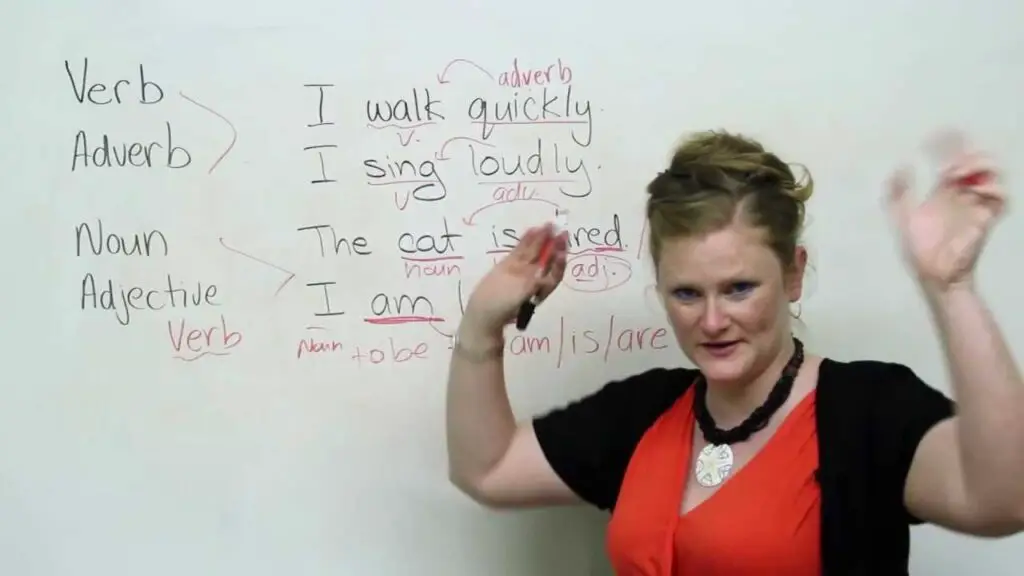
Verbs and adjectives are two of the most important word types in English. Verbs show actions and states. Adjectives describe nouns. Together, they bring sentences to life.
Many common grammar patterns combine the two, such as look happy, be afraid of or make someone angry. This guide explains how verbs and adjectives work together, with simple rules, tables and practice.
Quick Review: Verbs and Adjectives
- Verb: an action or state. run, write, be, seem
- Adjective: describes a noun or pronoun. tall, happy, difficult
Adjectives usually go before a noun (a difficult test) or after a linking verb (The test was difficult).
1. Linking Verbs + Adjective
Linking verbs connect the subject to an adjective that describes it. They do not show action.
| Linking verb | Example |
|---|---|
| be | She is tired. |
| seem / appear | He seems worried. |
| become / get | It’s getting cold. |
| look / sound | You look happy. That sounds great. |
| feel / taste / smell | I feel sick. The soup tastes salty. |
| stay / remain | Please stay calm. |
Important: use an adjective, not an adverb, after linking verbs. She looks beautiful (not beautifully). I feel bad (not badly).
Same Verb, Different Use
- She looked angry. (linking: she seemed angry → adjective)
- She looked angrily at me. (action: the way she looked → adverb)
2. Verb + Object + Adjective
Some verbs take an object followed by an adjective that describes the object.
- The news made her happy.
- Please keep the room clean.
- They found the test easy.
- Don’t leave the door open.
- She painted the wall blue.
3. Adjective + Preposition
Many adjectives are followed by a fixed preposition. These must be learned.
| Adjective + preposition | Example |
|---|---|
| afraid of | He is afraid of dogs. |
| good at / bad at | She is good at maths. |
| interested in | I am interested in science. |
| proud of | We are proud of you. |
| angry with (a person) / about (a thing) | She was angry with me about the delay. |
| different from | This book is different from that one. |
| famous for | Sylhet is famous for tea. |
| responsible for | Who is responsible for this? |
4. Adjective + To-Infinitive
- I am happy to help.
- It is easy to learn.
- She was surprised to see him.
5. -ed and -ing Adjectives From Verbs
Many adjectives come from verbs. The ending changes the meaning:
- -ed describes how a person feels: I am bored.
- -ing describes what causes the feeling: The film is boring.
Other pairs: interested/interesting, tired/tiring, excited/exciting, confused/confusing.
6. Order of Adjectives Before a Noun
When you use several adjectives, they usually follow this order: opinion – size – age – shape – colour – origin – material – purpose.
- a beautiful small old wooden box
- a big red plastic bag
Common Mistakes
- I feel badly. → I feel bad.
- I am boring in class. (if you mean your feeling) → I am bored in class.
- She is good in English. → She is good at English.
- He made me to laugh. → He made me laugh.
See more in our guide to common grammar mistakes, and check verb forms with our guide to the 12 tenses.
Practice
- The flowers smell (sweet / sweetly).
- The lecture was (bored / boring).
- She is interested (in / on) art.
- The noise made me (angry / angrily).
Answers: 1. sweet 2. boring 3. in 4. angry
Free Resources
The British Council’s LearnEnglish grammar lessons cover adjectives and verb patterns. Purdue OWL’s grammar guide explains adjectives and adverbs, and its grammar exercises help you practise.
Final Thoughts
Verbs and adjectives work together in fixed patterns. Use adjectives after linking verbs, learn the common adjective + preposition pairs, and remember the -ed/-ing difference. For more sentence-building help, read how to structure sentences.