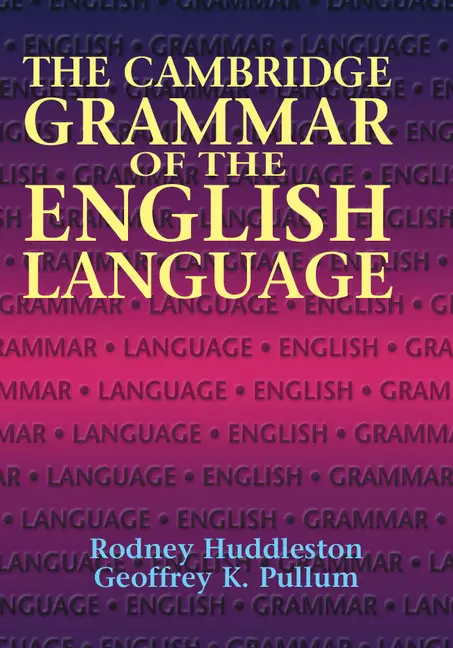
The Cambridge Grammar of the English Language (often shortened to CGEL) was written by Rodney Huddleston and Geoffrey K. Pullum with a team of contributors. Cambridge University Press published it in 2002. At around 1,800 pages, it is one of the most detailed descriptions of modern English grammar ever written.
This is a serious academic reference, not a learner’s textbook. This review explains who should read it, what makes it different from school grammar books, and which easier books to choose if you are still building your basics.
Who Is It For?
- Linguistics students and researchers.
- Teacher trainers and very advanced teachers.
- Editors and writers who want deep explanations.
It is not a learner’s book. If you are studying English as a second language, start with a practical book such as English Grammar in Use.
What Makes It Different
- Descriptive approach: it describes how Standard English actually works, rather than telling readers what is “correct”.
- Modern analysis: it revises some traditional categories. For example, it treats many words traditionally called subordinating conjunctions (such as before and after) as prepositions. It also separates word categories (such as noun) from functions (such as subject).
- Consistent terminology across the whole book.
The book won the Linguistic Society of America’s Leonard Bloomfield Book Award in 2004.
Strengths and Limitations
| Strengths | Limitations |
|---|---|
| Extremely thorough and rigorous | Very expensive and heavy |
| Clear, logical framework | Technical terms take time to learn |
| Rich examples | Some terms differ from school grammar and exam books |
A Note for Students in Bangladesh
School and board exams use traditional grammar terms (for example, “conjunction” for before and after). If you read CGEL, remember that your exam may expect the traditional labels. Use CGEL to deepen your understanding, not to replace your textbook.
An Easier Option From the Same Authors
Huddleston and Pullum also wrote A Student’s Introduction to English Grammar (2005; a second edition with Brett Reynolds appeared in 2022). It presents the same approach in a shorter, more accessible textbook with exercises.
How It Compares
- A Comprehensive Grammar of the English Language (Quirk et al.) is the older major reference grammar, using more traditional terms.
- Longman Grammar of Spoken and Written English is based on large collections of real texts and shows how grammar varies between speech and writing.
- CGEL offers the most modern and systematic analysis of the three.
Free Resources for Everyday Grammar
For day-to-day learning and practice, use the British Council’s LearnEnglish grammar lessons, Purdue OWL’s grammar guide and its free grammar exercises.
Verdict
The Cambridge Grammar of the English Language is a landmark reference for serious study of English grammar. It is best for linguists, teacher trainers and advanced readers. Most learners and teachers will get more everyday value from a practical grammar book, and can turn to CGEL when they want a deeper answer.